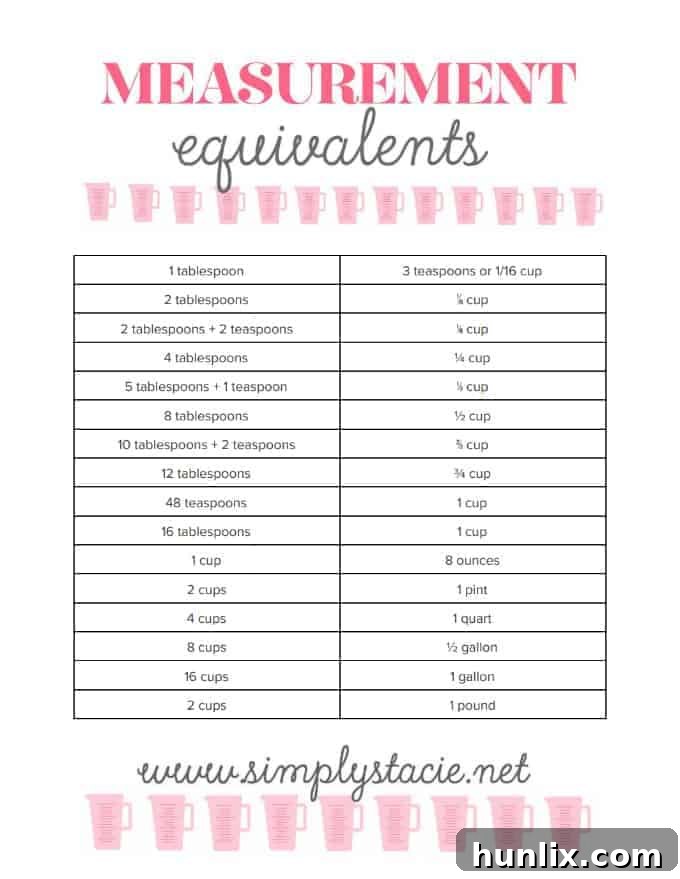
Every home cook, from the novice baker to the seasoned chef, understands the critical role accurate measurements play in crafting delicious dishes. Yet, navigating the world of cups, tablespoons, ounces, and grams can sometimes feel like solving a complex puzzle. Imagine the scenario: you’re in the middle of preparing a delicate sauce or a batch of cookies, and the recipe calls for an amount that doesn’t quite fit your available tools, or an ingredient comes in packaging with an opening too small for a standard measuring cup. This is precisely where a reliable Measurement Equivalents Chart becomes your kitchen’s ultimate ally. It transforms potential frustration into seamless execution, empowering you to confidently convert measurements on the fly and ensuring your culinary creations turn out perfectly every time.
I often find myself reaching for my own trusted Measurement Equivalents chart when I need an alternative, more convenient way to measure an ingredient. For instance, I might have a concentrated extract or a specific spice blend packaged with a narrow opening that makes pouring directly into a measuring cup difficult and messy. If it fits a tablespoon, I can quickly reference my chart to determine precisely how many tablespoons I’ll need to make up a quarter cup, a half cup, or whatever the required amount is. This free printable is incredibly handy to have readily accessible in the kitchen, serving as a quick, indispensable guide that eliminates guesswork and saves precious time during food preparation. It’s a simple tool that has come in handy for me countless times, making recipe execution smoother and more enjoyable.
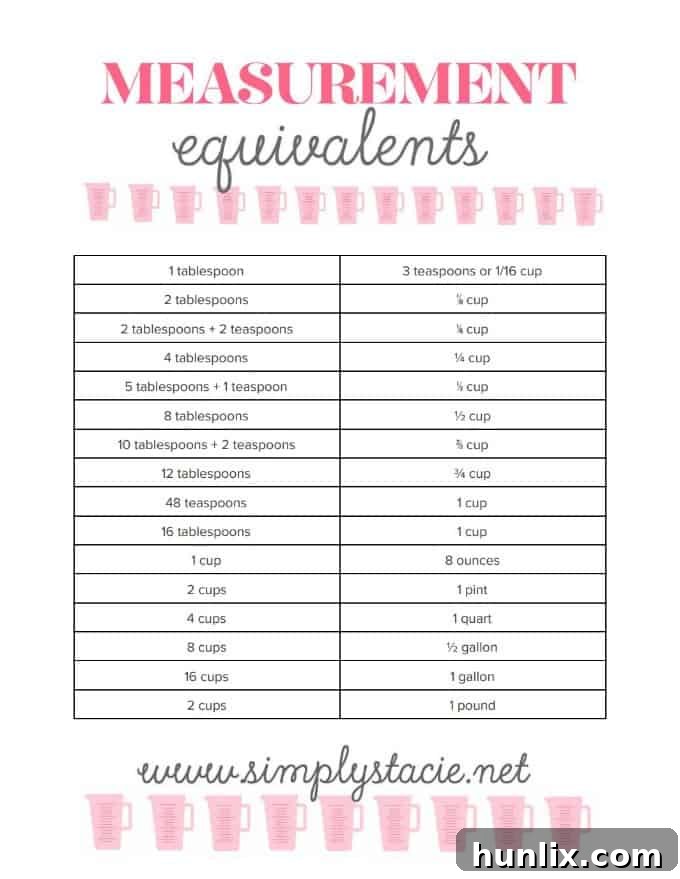
Master Your Kitchen with the Ultimate Measurement Equivalents Printable Chart
Why a Kitchen Measurement Conversion Chart is Indispensable for Every Cook
In the dynamic environment of a kitchen, precision is paramount. A seemingly small miscalculation in ingredients can dramatically alter the taste, texture, and overall success of a dish. This holds particularly true in baking, which is often described as a science, where ratios and exact quantities are crucial for proper chemical reactions. But even in savory cooking, getting proportions right is key to balancing flavors and achieving desired consistencies. A dedicated kitchen measurement conversion chart isn’t merely a convenience; it’s a foundational tool that empowers you to cook and bake with enhanced confidence and unwavering accuracy, turning good intentions into delicious realities.
Ensuring Recipe Accuracy and Consistent Culinary Success
Consider your favorite recipes; what makes them consistently good? Often, it’s the precise balance of ingredients. A spoonful too much salt, an extra half cup of liquid, or insufficient flour can turn a potentially perfect meal into a significant disappointment. Our Measurement Equivalents Chart acts as your personal culinary translator, ensuring that every measurement is spot-on. Whether you’re scaling a recipe up or down, or simply trying to convert “fluid ounces” to “tablespoons” when you’re short on specific tools, having these critical conversions at your fingertips prevents costly mistakes and ensures that your dishes consistently hit the mark. It’s the silent partner that guarantees consistent culinary success, making every dish a triumph.
Saving Time and Reducing Frustration During Food Preparation
How often have you found yourself pausing mid-recipe, frantically searching online for how many teaspoons are in a tablespoon or how many ounces make a cup? These interruptions break your cooking flow, steal valuable time, and can inject a significant amount of frustration into what should be an enjoyable and creative process. With our printable chart, those moments of hesitation vanish. It allows for quick, seamless conversions, keeping your cooking momentum strong and your focus on the task at hand. No more sticky fingers on your phone or laptop while you Google a conversion; a quick glance at your neatly placed chart is all it takes to keep things moving smoothly. This efficiency not only saves precious minutes but also makes the entire cooking experience more pleasant and considerably less stressful.
Handling Diverse Ingredient Packaging and Measurement Tools
The culinary world is rich in variety, and that extends to how ingredients are packaged and how we measure them. From tiny spice jars with narrow openings to large bottles of syrups that are difficult to pour precisely into small measuring spoons, different packaging can present unique challenges. Sometimes, you might only have a tablespoon available when the recipe calls for a quarter cup, or vice-versa. Our conversion chart expertly bridges these gaps. It provides the necessary equivalencies that allow you to adapt to whatever tools and packaging you have on hand, ensuring you can still measure accurately without making a mess, wasting ingredients, or resorting to inaccurate guesstimates. This adaptability is key for a truly versatile and efficient kitchen, enabling you to tackle any recipe with confidence.
Bridging Measurement Systems (A Stepping Stone for the Global Kitchen)
While this particular chart is primarily optimized for common US customary measurements, understanding measurement equivalents lays a crucial groundwork for navigating global recipes. Many international recipes predominantly use the metric system (grams, milliliters, liters). By mastering the conversions within one system, you build a fundamental understanding of how different units relate, making it significantly easier to eventually tackle metric conversions or confidently interpret recipes from around the world. Our chart focuses on the conversions you’ll use most often in day-to-day American cooking and baking, making it a powerful and accessible starting point for any home cook looking to enhance their global culinary skills and broaden their recipe repertoire.
What Makes This Free Printable Chart So Special?
You might wonder why this particular printable is designed in its current form, rather than being an exhaustive compendium of every conceivable conversion. The truth is, including every single possible conversion imaginable would result in an enormous, unwieldy chart that would be overwhelming, cluttered, and incredibly difficult to use quickly and efficiently. To ensure maximum utility, clarity, and ease of reference, I’ve carefully curated this printable to feature only the conversions that are used most often in everyday cooking and baking. These are the “go-to” equivalencies that home cooks reach for time and time again – from standard liquid and dry measurements to common weight conversions for staples like butter, flour, and sugar.
This focused approach means the chart is concise, highly readable, and immediately actionable. It’s designed to be a practical, functional tool that enhances your cooking process, not an academic encyclopedia. Of course, there might be an occasional, less common conversion you need to look up. For those rare instances, the internet remains an invaluable resource. Simply open your preferred search engine, type in the specific conversion you need (e.g., “how many drams in an ounce” or “convert gill to cup”), and it usually appears as the very first and most relevant search result. Our printable covers the vast majority (easily 95%) of your daily kitchen conversion needs, keeping your essential information readily available, uncluttered, and always at your fingertips.
How to Get the Most Out of Your Free Measurement Equivalents Printable
Having a valuable tool is one thing; knowing how to integrate it effectively into your daily routine is another. This Measurement Equivalents printable is designed to be highly functional, but its true potential is unlocked by thoughtful placement and consistent use. Here are some practical tips to help you maximize its benefits and streamline your cooking process in the kitchen.
Print and Place Strategically for Unmatched Easy Access
The first and most crucial step is simple: print out this invaluable Measurement Equivalents printable. Once you have it in hand, take a moment to consider where it will be most useful and accessible in your kitchen. Many people choose to add it to a household binder, which is excellent for organization. However, for immediate, hands-on access during the heat of cooking, consider placing it somewhere highly visible and easily reachable. This could mean:
- On the Refrigerator: Secure it with a magnet for instant visibility and a quick glance.
- Inside a Cabinet Door: Tape it discreetly to the inside of a cabinet that you frequently open while cooking.
- Laminated on a Wall: If you have a dedicated cooking nook or a clear wall space, laminating it makes it incredibly durable, resistant to kitchen splatters, and easy to wipe clean.
- In a Recipe Binder: Keep it alongside your favorite recipes for quick reference while planning or actively preparing meals.
The ultimate goal is to have it within arm’s reach, minimizing the time it takes to look up a conversion and keeping your precious cooking flow uninterrupted and efficient.
Learn and Internalize Your Most Frequent Conversions Over Time
While the chart is fantastic for quick reference, consistent exposure to these equivalencies will naturally lead to gradual memorization. The more you refer to it, the more those common conversions – like how many teaspoons are in a tablespoon, or how many ounces constitute a cup – will become second nature to you. It’s a progressive process, but over time, you’ll find yourself needing to consult the chart less and less frequently. You’ll develop an intuitive understanding of measurements, which is a hallmark of an experienced, confident, and efficient cook. I’m certainly not at that point yet for every single conversion on the chart, but I’m getting there, one delicious and accurately measured recipe at a time!
A Lifelong Kitchen Companion for Cooks of All Skill Levels
This printable isn’t exclusively for beginners; it serves as an incredibly valuable aid for cooks of all skill levels. Even highly experienced chefs can benefit from a quick reference, especially when dealing with a new, unfamiliar recipe, or converting an ingredient quantity they don’t frequently use. It’s a versatile tool that grows with you, from the initial learning phase where every conversion is new, to moments where you simply need a quick double-check or a reminder. Consider it a permanent, essential fixture in your culinary arsenal, always ready to assist you in achieving perfect and consistent results, no matter your experience level.
Common Measurement Challenges and How to Overcome Them
Even with a comprehensive conversion chart, certain aspects of measuring can be inherently tricky. Understanding these nuances can further enhance your accuracy, reduce potential errors, and ultimately lead to greater cooking success.
Understanding the Distinction Between Volume vs. Weight Measurements
Many recipes, particularly prevalent in the US, primarily rely on volume measurements (cups, tablespoons). However, for ingredients like flour, sugar, or even chocolate, weight measurements (grams, ounces) are often inherently more accurate. A “cup” of flour, for instance, can vary significantly in weight depending on how it’s scooped and packed. While our chart primarily focuses on common volume conversions, it’s worth noting that for critical baking recipes, investing in a good kitchen scale can be invaluable for achieving precise, weight-based accuracy. Our chart helps you navigate the common volume conversions you’ll encounter daily, ensuring consistent results without needing a scale for every item.
Using the Right Measuring Tools: Liquid vs. Dry Measuring Cups
It might seem like a minor detail, but using the correct type of measuring cup is surprisingly important for accuracy. Dry measuring cups (which you level off with a straight edge) are specifically designed for dry ingredients like flour, granulated sugar, and spices. Liquid measuring cups, typically clear with a spout and measurements printed below the rim, are designed for liquids such as water, milk, oil, and stocks. When measuring liquids, the meniscus (the slight curve of the liquid surface) should always be read at eye level for the most accurate measurement. Using the right tool ensures you’re getting the intended amount, whether you’re pouring from a tricky bottle or scooping from a bin.
Beyond the Chart: Essential Tips for Accurate Measuring in the Kitchen
While a fantastic conversion chart is incredibly helpful, mastering a few fundamental measuring techniques will elevate your cooking and baking precision even further. These practices complement your chart, ensuring every step of your ingredient preparation is flawless.
Always Use the Right Tools for the Job
Invest in a comprehensive set of standard measuring cups and spoons for dry ingredients, ensuring they are clearly marked. Additionally, acquire at least one good quality clear liquid measuring cup for liquids. Consistency in your tools directly leads to consistency and reliability in your culinary results.
Level Off Dry Ingredients Properly and Precisely
For most dry ingredients like flour, granulated sugar, or cocoa powder, scoop the ingredient into the measuring cup until it overflows slightly. Then, use the straight edge of a knife, a flat spatula, or even the back of a spoon to level off the excess, ensuring an accurate, unpacked measure. This method is crucial unless the recipe specifically instructs you to “pack” the ingredient.
Measure Liquids Accurately at Eye Level
To measure liquids precisely, pour the liquid into a clear measuring cup that is placed on a flat, stable surface. Then, bend down so your eyes are perfectly level with the measurement line to get an accurate reading, thereby avoiding common parallax errors that can lead to over or under-measuring.
Do Not Pack Ingredients Unless Explicitly Specified (The Brown Sugar Exception)
For the vast majority of dry ingredients, you want a light, uncompressed measure for accuracy. Scooping loosely and leveling off is key. The notable and almost universal exception to this rule is brown sugar, which recipes almost always instruct you to pack tightly into the measuring cup to remove air pockets and achieve the correct density and amount.
Bring Ingredients to Room Temperature When Required
Especially crucial in baking, ingredients like butter and eggs often need to be at room temperature for proper emulsification, aeration, and achieving the desired texture in your final product. While not directly a measurement conversion, it’s a critical part of measurement accuracy as temperature significantly affects the density and volume of certain ingredients.
Get Your Free Measurement Equivalents Printable Today!
Ready to infuse unparalleled precision and effortless ease into your kitchen endeavors? Stop guessing and start cooking with unwavering confidence! Our free, user-friendly Measurement Equivalents printable chart is meticulously designed to be an invaluable resource that you’ll turn to again and again. It consolidates the most essential and frequently used conversions, effectively eliminates all guesswork, and consistently helps you achieve perfect, consistent results in all your cooking and baking endeavors, transforming every recipe into a delightful success.
This fantastic resource will profoundly simplify your culinary life, whether you’re converting tablespoons to cups, ounces to pounds, or simply need a quick, reliable reminder of common liquid and dry volumes. It’s perfectly sized for convenience and thoughtfully organized with clear, legible text to make finding exactly what you need a swift and effortless breeze, even during the busiest moments in your kitchen.
To receive this indispensable Measurements Equivalent printable delivered right to your inbox, simply fill out the form provided below! Once you submit your details, a direct link to download your free, high-quality chart will be sent directly to you, ready for immediate printing and instant use in your kitchen. Don’t miss out on this opportunity to make your cooking journey smoother, significantly more accurate, and immeasurably more enjoyable!